
Member login

What we do · How we work

Conservation

We interpret historic dry stone structures and offer custom conservation solutions.

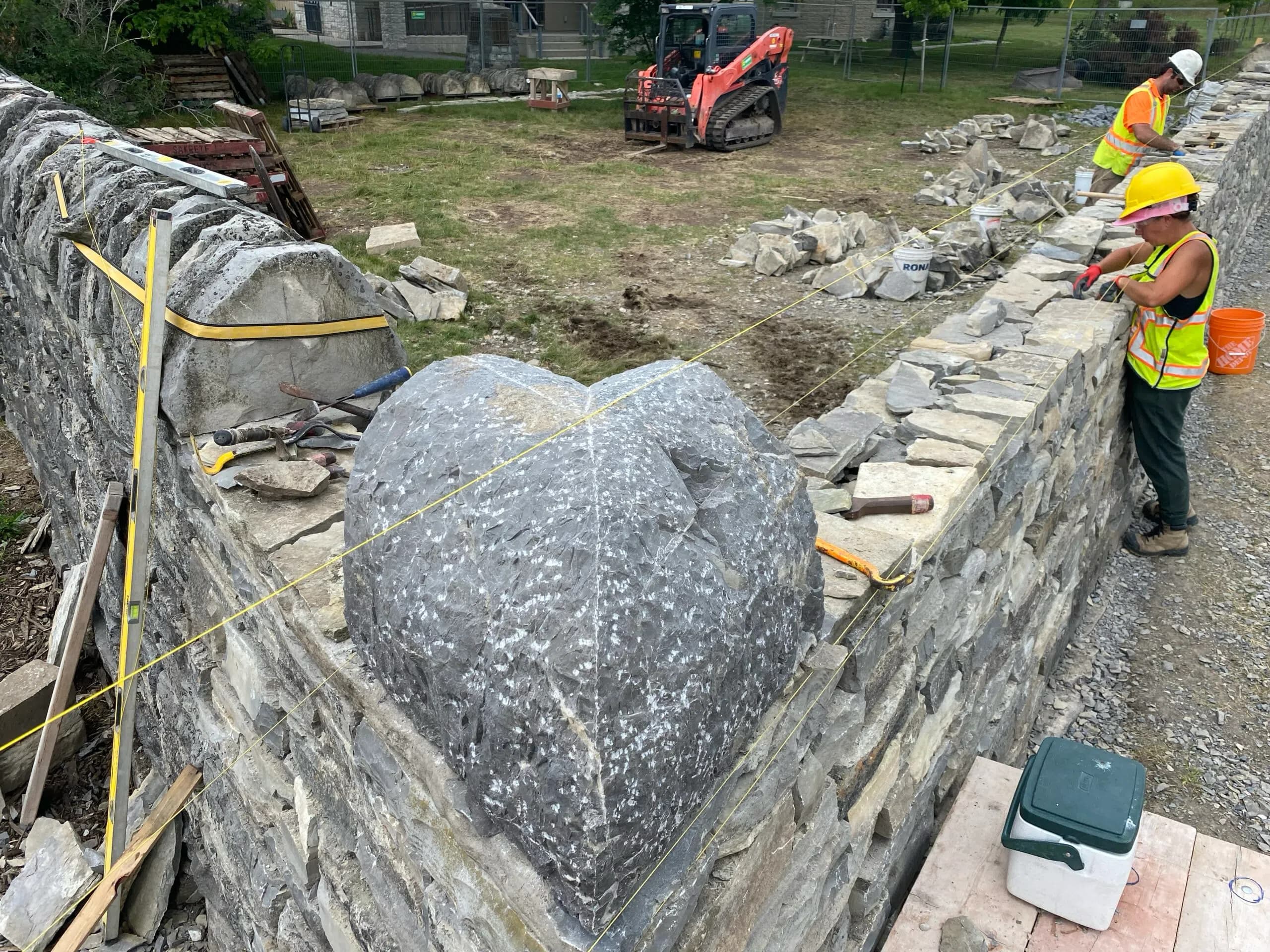
Two wallers coursing the relocated Kingston wall along a string line, with a large shaped corner stone set on the wall end in the foreground.
Kingston Frontenac Public Library · Kingston, ONCorner tie-in and coping on the relocated wall · 2021–2023

The craft

Certified wallers and conservation wallers

A dry stone waller is a craftsperson skilled at constructing a variety of dry stone walls, both freestanding and retaining. A conservation waller is a stonemason certified in the construction and repair of traditional dry stone wall types, and trained in the methods and the unique safety aspects of historic sites.

What certification is

Certification is accumulated experience working with various types of stone using recognized dry stone practices, followed by supervised testing in the field. Our members are certified through the Dry Stone Walling Association scheme, from Level 1 through Master Craftsman, with Level 2 and up working on site.

The institutions we recognize

What conservation adds

Conservation wallers are competent in identifying the physical characteristics and bonding patterns of different walls, which link the waves of settlement in Canada to their ancestral origins overseas. In interpreting the cultural significance of Canada's original dry stone walls, a conservation waller can discuss repair and restoration alternatives with an architectural conservator and help determine the most appropriate treatment and maintenance schedule for the site.

What we do

Three disciplines

We provide technical planning and reporting support, in addition to onsite conservation of historic dry stone walls.

Dry stone rebuilding

A wall goes back up on its record rather than from memory. Foundations are built to bedrock or a compacted granular base with the largest, best-fitted stones in the lower courses; the original bond pattern is reproduced, running joints are eliminated, and through stones are set at metre intervals halfway up the height, with a coverband course presenting a level surface for the copings. Where the record supports an improvement it is made quietly — slightly widening the base, for instance, while keeping height and upper dimensions original, without altering the original bond and overall appearance.
Heritage masonry repair

Not every historic wall is dry the whole way through. The wall at the Little Dutch Church had been extended around an adjacent property in mortar and capped in formed concrete after the Halifax explosion of 1917, and its rebuilt copings were mortared in place to deter vandalism. Work of that kind needs stone matched to the original — at Halifax, ironstone slate from a small quarry north of the city — and a mason qualified in both traditions. John Scott, the co-operative's president, is a licensed Red Seal stonemason with a diploma in heritage masonry, and led the heritage masonry program at Algonquin College.

Survey and documentation

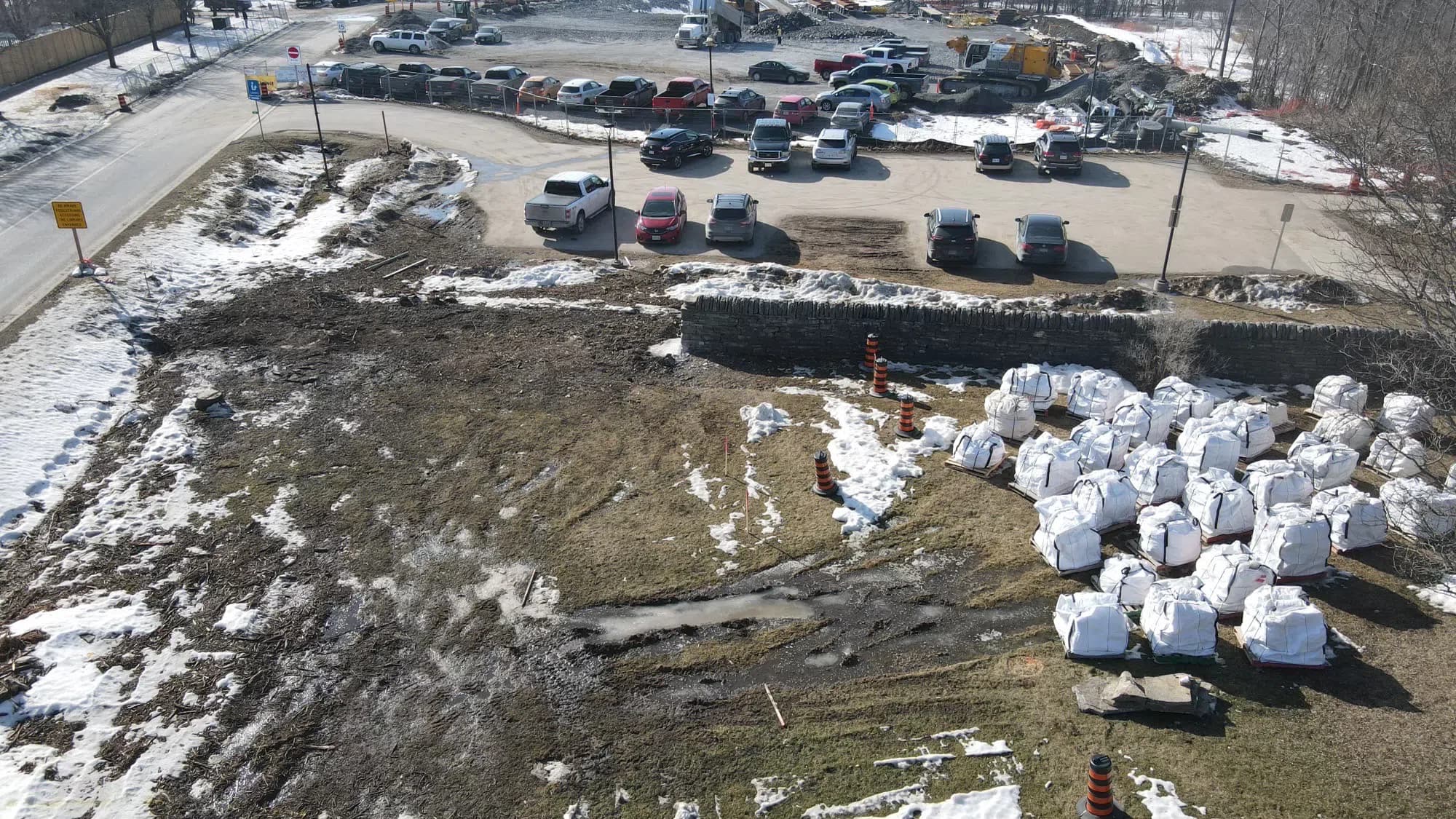
A wall can be recorded without being touched, and on some projects the record is the whole of the work. Overall layout, components and dimensions are recorded along with bond patterns, variations and suspected past repairs; at Kingston the wall was divided into one-metre sections and each was recorded individually from both sides. Where a wall is coming down, the dismantling is itself a survey — each linear metre is opened in cross-section to show stone orientation, through stones and hearting, and every metre is bagged, labelled and mapped before it leaves the site.

Aerial view of the Kingston site in winter: the standing limestone wall, and forty-odd labelled pallet bags of inventoried stone laid out on the ground beside it.
Kingston Frontenac Public Library · Kingston, ONSixteen metres of wall, bagged by the metre and mapped · 2021–2023

Standards and Guidelines

We work to the Standards and Guidelines for the Conservation of Historic Places in Canada when assessing, planning, executing and reporting on a project — especially when working alongside other conservation professionals.

How a project runs

Recorded first, reported last

Nothing is moved before it is recorded, and nothing is closed out before it is reported. In between, the order does not change.

  1. Record

    Overall layout, components and dimensions, bond patterns, variations and suspected past repairs. The wall is divided into one-metre sections and each is recorded individually from both sides.

  2. Cross-section

    Dismantling runs in one-metre increments so that each linear metre can be recorded in section — stone orientation, through stones, hearting.

  3. Dismantle

    Copings, coverbands, bookend and corner stones come off in order and are labelled as they go. Where the work leaves an open end standing, a temporary cheekend stabilises it.

  4. Inventory and store

    Each metre goes into a pallet bag banded shut, with its contents listed on a label inside and a label outside. Bags are moved to storage and mapped by location and contents.

  5. Rebuild

    Foundations first, then the courses: largest stones low, the original bond reproduced, through stones at metre intervals, a coverband course and the copings to finish.

  6. Report

    A final report carrying the recording data, a photographic account of the disassembly, what was found inside the wall, and where the stone was stored.

Who should consider hiring us

Managers and custodians of historic properties with dry stone features.

  • National Historic Sites
  • Provincially managed heritage sites
  • Municipal historic properties
  • Ecclesiastic places
  • Historic universities and private colleges

And who should not

The co-operative works on designated and historic properties. That rules out most residential and commercial work:

  • Homeowners
  • Shopping centres
  • Golf courses
  • Subdivision developers

Where the method is on the record

The Little Dutch Church National Historic Site in Halifax, the library wall in Kingston, and the solar alignment pillar on Amherst Island.

See our projects